We have more than 1,000 AI voice agents running for our customers today, across many industries and roles. That gives us a clear view of what works: which agents customers adopt first, which ones they add next, and where each one pays for itself fastest. We know this space, and we want to help you bring it to your customers.
Your customers are already researching AI. Most are curious, and many are still confused. Meanwhile they miss calls after hours, their front desk turns over every few months, and owners are on job sites instead of at a desk. They don't want to design an AI agent. They want one that answers the phone tomorrow.
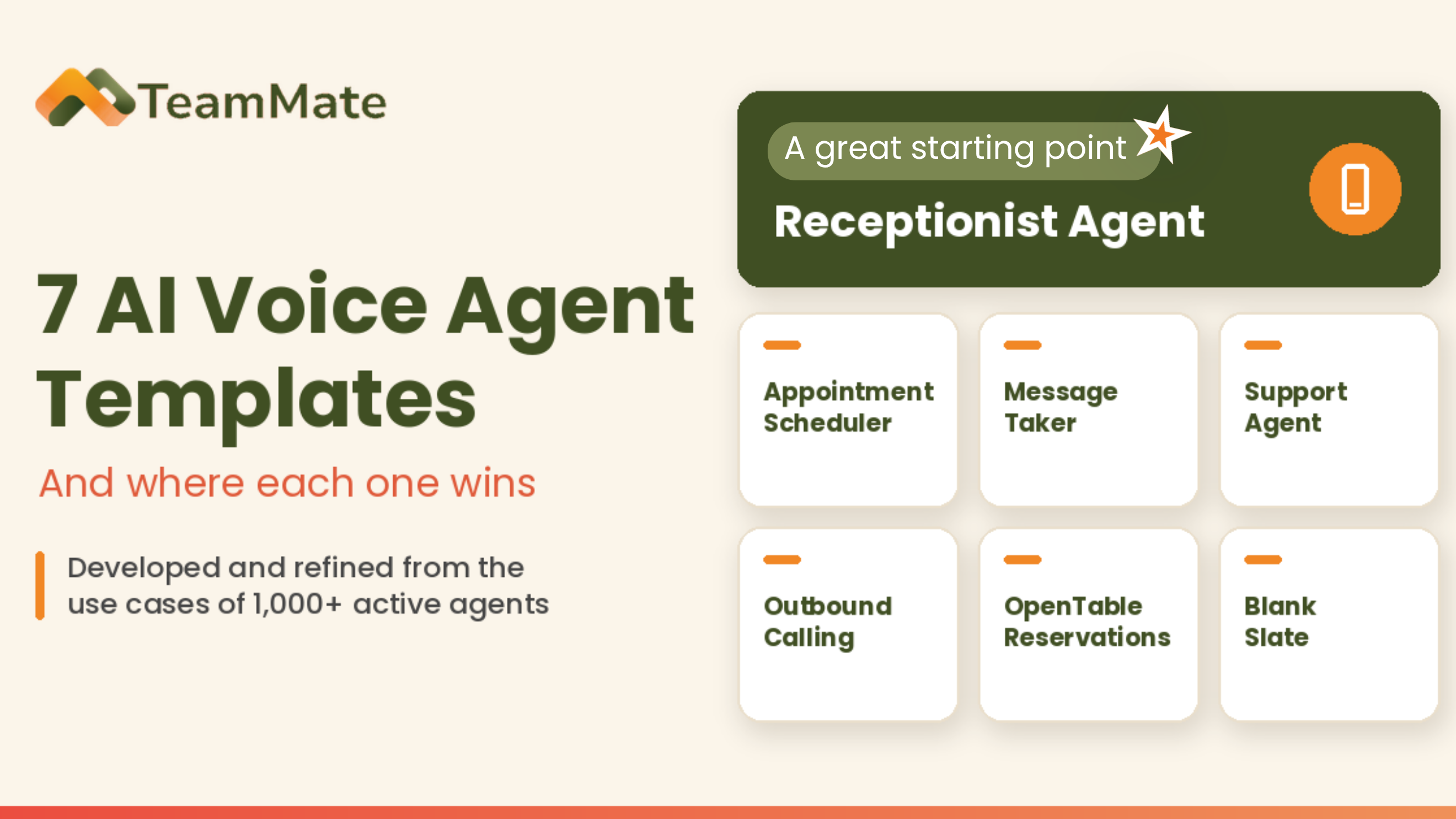
That is why every TeamMate AI Voice Agent starts from a template. Below are the seven we offer, the businesses each one fits best, and how you can turn them into recurring revenue today and a platform for the opportunities ahead.
Why one generic agent isn't enough
Many businesses that try AI voice get stuck at the same place. They are offered a single, generic "AI agent" and told it can do everything. In practice, an agent built to do everything is tuned for nothing. It answers the phone, but it doesn't know how to book against a calendar, work a support ticket or confirm a reservation, so the customer ends up rewriting it from scratch or giving up.
TeamMate takes a different approach. We offer a set of agents, each tuned for a specific job, built from what we've learned running more than 1,000 of them. A customer starts with the one that fits their biggest problem, then adds the next when they're ready. And the list keeps growing as partners bring us new use cases, we turn the ones that repeat into new templates.
Seven templates, built from real deployments
Each template is a working agent out of the box. Edit its instructions to fit the customer, or start from scratch. Most customers begin with the Receptionist, and once they see what one agent can do, the second one is an easy yes.
1. Receptionist Agent
Every business has calls it can't afford to miss. The Receptionist Agent is our most popular template because it is the easiest place to start: almost every business has a receptionist role, or wishes it could afford one. It greets every caller in the business's own name, answers common questions, screens out spam and transfers callers to the right person or department, day or night. It also fixes a turnover problem. Front desk roles churn, and every new hire means retraining. The agent learns it once and delivers it the same way every time.
Best fit: field service companies, where a missed call is a lost job and the owner is on a ladder, not at a desk. One of our live deployments is a local handyman business that now sounds like an established company on every call. The same agent can live on the customer's website too, so visitors tap Chat with Agent and get the same answers any time of day.
2. Appointment Scheduler
The Appointment Scheduler books, reschedules and cancels appointments against live availability in Google or Outlook Calendar. Callers who ring at 9 p.m. get booked instead of leaving a voicemail.
Best fit: practices, clinics, salons and home services, any business run off a calendar. Healthcare front desks in particular are buried in booking and confirmation calls. Sensitive details are redacted from transcripts and records, and we will sign a Business Associate Agreement, so healthcare deals don't stall in compliance review.
3. Message Taker Agent
The Message Taker answers common questions, captures a detailed message and sends it to the right person with the full transcript and recording. Nothing is lost between the call and the callback.
Best fit: legal offices and professional services firms. Each new lead can be worth thousands, and the firm that answers first usually wins the client. When attorneys are in court or in meetings, the prospect still reaches someone instead of voicemail. It is also the lowest-risk way to prove the concept with a new customer.
4. Support Agent (CRM)
The Support Agent connects to Zendesk, Freshdesk or any system with a Model Context Protocol (MCP) server. It handles support calls with real ticket and account context, then opens or updates tickets and escalates with a clean handoff. It confirms who it is talking to before it releases any information.
Best fit: MSPs, IT support desks and technology providers. Password resets and "is it down?" calls are pure repetition. Let the agent take tier-1, including on your own helpdesk, so your technicians work the tickets that need them.
5. Outbound Calling Agent
The Outbound Calling Agent places calls instead of answering them: appointment reminders, confirmations, renewals, follow-up campaigns and a nudge when a payment is due. When someone reschedules, it updates the calendar. It is often the second agent a customer adds.
Best fit: clinics and service businesses fighting no-shows, auto service shops, and any business with renewals or recurring billing. As with any outbound program, make sure campaigns follow the calling and consent rules in your customer's market.
6. OpenTable Reservation Agent
The OpenTable Reservation Agent answers a restaurant's calls, checks real table availability on OpenTable and texts the caller a pre-filled booking link. It shows how far a vertical template can go.
Best fit: restaurants and hospitality venues, where the phone rings hardest during the dinner rush, exactly when staff can't pick up.
7. Blank Slate Agent
The Blank Slate Agent starts from scratch, with full flexibility, briefed in plain English like any other agent. Our team can help with the first build.
Best fit: workflows no template covers. Think multi-site franchises that need the same answers at every location, order status lines, lead qualification or taking a card payment on the call.
You don't program it. You brief it.
Every template is set up in plain English, the same way you'd train a new hire. No code and no telephony expertise.
1. Point it at the website. The agent learns from everything the business already publishes, and answers from that material, not the open internet.
2. Set the greeting. This is exactly what callers hear when the agent picks up. An optional personalized greeting can welcome returning callers by name, using data from the customer's CRM.
3. Write the instructions. Give it a personality, tell it what to say when someone asks for a price, and tell it what to collect, such as a name, callback number and project details. Want it to behave differently? Edit the text.
One of our live agents runs on about eight pages of plain writing. Anyone who can brief a new employee can set one up.
Where AI voice agents shine, and where they don't
Most customers are curious but still cautious, so sell it honestly and skip the hype.
Where it shines:
• Tier-1 call handling
• Deep knowledge of the business from day one
• Overflow and after-hours coverage
• Reception and inbound sales
• Qualifying a caller, then a clean handoff to a person
What to tell customers up front:
• It is not a full replacement for people.
• It is not for complex, judgment-heavy calls or professional opinions.
• Promise a tireless front desk, not a robot employee.
How it fits the phone service you already sell
• Microsoft Teams: works with Operator Connect, Direct Routing or Microsoft Calling Plans. The agent looks up users in the Teams directory, and Adaptive Call Cards show what the caller wants while the phone rings.
• Your UCaaS platform: the agent registers as an extension, works with existing routing rules and dial plans, and transfers calls to any extension.
• A record of every call: each call is transcribed and summarized, with sensitive details redacted.
• Every channel: the same agent, prompt and knowledge work across voice, SMS and chat, in 40+ languages.
• Your brand: white-label, with your brand, your domain and your pricing.
Turn templates into a product line
Your customers will buy AI voice from someone. It should be you. AI voice agents ride on top of the UCaaS and Teams calling you already sell, as a straightforward add-on. Partners typically add $50 to $250 per account each month, there is room for several agents per account, and a customer running agents on your platform has one more reason to stay. We deliver the agent at a preset cost, and you set your markup.
Service providers can start with a free 30-day proof of concept, and our partner program is built to help you sell.
Ready to see the templates in action? Book a demo or explore AI Voice Agents.