What is a Teams Phone AI agent? It's an AI that answers calls on a Microsoft Teams Phone line, works out what the caller needs, and either helps or routes the call to the right person. Microsoft sells its own, Teams Phone Agent, which became generally available on September 30, 2026. Other vendors, including TeamMate, offer AI voice agents that work with Teams Phone too. Which one fits depends on who is buying, which Teams Phone setup you run (Direct Routing, Operator Connect or Microsoft Calling Plans), and whether a service provider will sell and support it.
This guide explains what Microsoft's agent does, what it needs, how other agents work with Teams Phone, and what to check before you choose. It's a neutral overview, not a complete list of every option.
What does Microsoft's Teams Phone Agent do?
Microsoft describes Teams Phone Agent as "an AI-powered calling receptionist" that answers incoming calls and scales during call-volume spikes and after hours. Per Microsoft, it can:
- Answer questions from FAQ files and URLs the organization configures.
- Handle appointments: set up, reschedule, cancel or review them through integrations the organization configures.
- Route callers with context to an employee or department, with AI-generated conversation notes for the person who picks up.
- Speak 60+ languages and locales, with 42 voices as of October 14, 2026.
A Teams administrator creates it in the Teams admin center under Voice, Auto attendants, Add, Teams Phone Agent (Microsoft's setup guide). Organizations can also connect custom voice agents built in Microsoft Copilot Studio, which Microsoft lists as available in Frontier preview.
What does Microsoft's Teams Phone Agent need?
According to Microsoft's licensing prerequisites, it needs at least one Teams Phone license, a free Teams Phone Resource Account license for each resource account, and Copilot Credits with a funded spending policy. Billing is usage-based. If no funded policy exists, Microsoft says the agent acts as an auto attendant.
For phone numbers, Microsoft's setup guide for voice-enabling Copilot Studio agents lists Calling Plans, Operator Connect and Direct Routing as the number types for an AI Agent resource account.
How do other AI voice agents work with Teams Phone?
Microsoft describes one route itself. Its Teams Phone extensibility (Unify) model lets third-party voice agents answer calls, authenticate callers, capture intent and route the call to an auto attendant, call queue or Teams user with the caller's context. Microsoft says this works from Teams Phone Agent or auto attendant routing, from call queue exception handling, or directly to the voice agent.
Microsoft runs a certification program for this model. As of November 14, 2026, Microsoft's list named Audiocodes, CentrePal, Heedify and NiCE/Cognigy. Those are examples, not a complete list of voice agents that work with Teams, and the list can change. Microsoft also says it supports voice agents only from certified partners and "may reject support cases where a noncertified voice agents solution is used," so ask any vendor who supports you.
Voice agents that aren't on that list also work with Teams Phone, TeamMate's among them. Direct Routing, for example, lets an organization connect its own telephony infrastructure to Teams Phone through a Session Border Controller (SBC), as Microsoft's Direct Routing guide describes.
How does TeamMate AI Voice Agents work with Teams Phone?
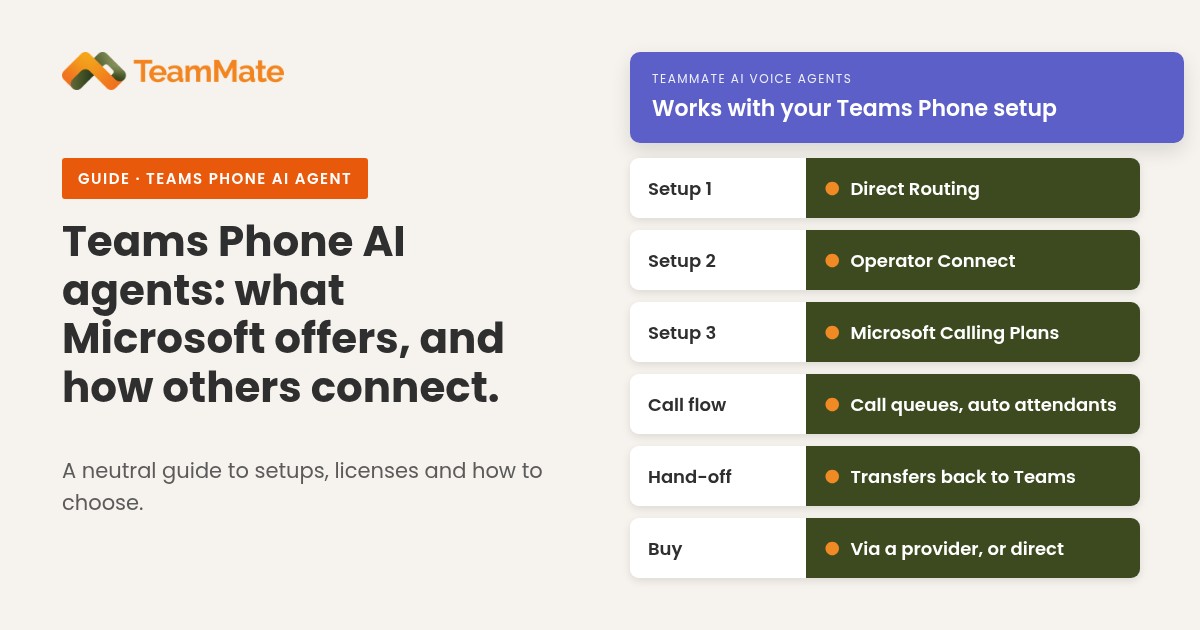
TeamMate AI Voice Agents works with Direct Routing, Operator Connect and Microsoft Calling Plans. It can sit behind Teams call queues and auto attendants and transfer the call back to Teams. The agent looks up users in the Teams directory, and Adaptive Call Cards show caller intent while the phone rings.
- How calls reach it: through a direct route that TeamMate creates and manages. It works the same way for customers on Direct Routing, Operator Connect or Microsoft Calling Plans.
- License: the agent needs a Teams license and a Phone System (Teams Phone) license, and each Teams user it works with needs a Teams Phone license.
- Certification: TeamMate is not on Microsoft's Unify voice agent list, and Microsoft does not certify TeamMate or its voice agents.
- What it does: start from a template (Transfer, Message Taker, Scheduling, After Hours Helpdesk, Appointment Reminder, Translator, Notetaker) or build your own. It answers from your own knowledge base, with 40+ languages and sub-100ms response time. See 7 AI voice agent templates and the features customers pay for.
- Proof: 1,000+ agents running. Sensitive details are redacted from transcripts, and TeamMate will sign a Business Associate Agreement for healthcare clients.
- Beyond Teams: the same agents run on a provider's own phone system, such as NetSapiens.
- Who buys it: service providers resell it white-label under their own brand, and end customers can buy it directly from TeamMate through its sales team. There is a 7-day free trial.
Which option fits which customer?
| Microsoft Teams Phone Agent | TeamMate AI Voice Agents | |
|---|---|---|
| Who sells it | Microsoft, to the customer. Microsoft's documentation describes no resale version. | Service providers resell it white-label. End customers can also buy it directly from TeamMate. |
| Teams Phone setups | Numbers on Calling Plans, Operator Connect or Direct Routing, per Microsoft's setup guide. | Direct Routing, Operator Connect and Microsoft Calling Plans. TeamMate creates and manages the direct route calls take to the agent. |
| Where it sits | Created in the customer's Teams admin center as an auto attendant. | Behind Teams call queues and auto attendants, transferring back to Teams. |
| Licensing | Teams Phone license, free resource account license, Copilot Credits. | A Teams license and a Phone System (Teams Phone) license for the agent, plus Teams Phone licenses for the users it works with. |
| Beyond Teams | Teams Phone resource accounts. | Also runs on the provider's own phone system, such as NetSapiens. |
| Microsoft certification | A first-party Microsoft feature. | Microsoft does not certify TeamMate or its voice agents. |
Microsoft's agent suits an organization that already runs Teams Phone, manages its own Microsoft 365 tenant and wants a smarter auto attendant it administers itself. A provider-sold agent suits a customer that wants a service provider to deploy it, brand it and support it. Neither is better for everyone, and certified agents from other vendors are a third route.
Can a service provider resell a Teams Phone AI agent?
Microsoft's documentation describes no white-label or resale version of Teams Phone Agent, so a provider can supply the phone numbers or Teams Phone licenses but not resell the agent. TeamMate AI Voice Agents is built for resale: your brand, your domain and your pricing, with first-line support from you and escalation to TeamMate. See Selling AI Voice Agents for Microsoft Teams for a six-point checklist, and Why Not Just Use Microsoft's Own AI? for the provider view of Microsoft's agent.
What does an AI receptionist cost?
Microsoft bills Teams Phone Agent by usage in Copilot Credits, so there's no fixed per-agent price. The market average selling price for an AI receptionist is about $50 to $250 per account per month. That is a market average, not TeamMate pricing.
What should you check before choosing a Teams Phone AI agent?
- Your Teams Phone setup. Direct Routing, Operator Connect or Calling Plans: does the agent work with yours?
- Call flow. How do calls reach the agent, can it sit behind your call queues and auto attendants, and can it transfer back to Teams users?
- Licenses. What does the agent itself need, and what do your users need?
- Support. Who do you call when it mishears a caller, and what does Microsoft support?
- Fit for the job. Languages, knowledge sources, scheduling, messages and any compliance needs such as a Business Associate Agreement.
- Cost model. Usage-based credits, a per-account price or a provider's own pricing.
Frequently asked questions
What is a Teams Phone AI agent?
A Teams Phone AI agent is an AI that answers calls on a Microsoft Teams Phone line, works out what the caller needs, and either helps or routes the call to the right person. Microsoft sells its own, Teams Phone Agent, and other vendors offer AI voice agents that work with Teams Phone too.
Does Microsoft Teams Phone have a built-in AI receptionist?
Yes. Teams Phone Agent became generally available on September 30, 2026. It answers questions from knowledge sources the organization configures, handles appointments, and routes callers with conversation notes. A Teams administrator creates it in the Teams admin center.
Can I use a third-party AI agent with Microsoft Teams Phone?
Yes. Microsoft's Teams Phone extensibility (Unify) model lets certified third-party voice agents answer calls and route them to Teams Phone destinations. Other vendors, including TeamMate, offer AI voice agents that work with Teams Phone numbers and call flows.
Which Teams Phone setups does TeamMate AI Voice Agents work with?
Direct Routing, Operator Connect and Microsoft Calling Plans. Calls reach the agent through a direct route that TeamMate creates and manages. It works the same way whether the customer uses Direct Routing, Operator Connect or Microsoft Calling Plans.
Can an AI agent sit behind a call queue or auto attendant and transfer back to Teams?
TeamMate AI Voice Agents can sit behind Teams call queues and auto attendants and transfer the call back to Teams. Microsoft's own model for certified third-party agents also routes calls to auto attendants, call queues and individual Teams users.
What license does an AI agent need on Teams Phone?
For Microsoft's Teams Phone Agent: at least one Teams Phone license, a free Teams Phone Resource Account license for each resource account, and Copilot Credits with a funded spending policy. For TeamMate AI Voice Agents: the agent needs a Teams license and a Phone System (Teams Phone) license, and each Teams user it works with needs a Teams Phone license.
How much does Teams Phone Agent cost?
Microsoft bills Teams Phone Agent by usage, in Copilot Credits, so there is no fixed per-agent price. Microsoft offers a Copilot Credit Estimator for planning.
How much does an AI receptionist cost on average?
The market average selling price for an AI receptionist is about $50 to $250 per account per month. That is a market average, not TeamMate pricing.
Can a service provider resell an AI agent for Teams Phone?
Microsoft's documentation describes no resale version of Teams Phone Agent. TeamMate AI Voice Agents is white-label, so service providers sell it under their own brand, domain and pricing.
Can my company buy TeamMate AI Voice Agents directly?
Yes. End customers buy TeamMate AI Voice Agents directly from TeamMate, through its sales team, and there is a 7-day free trial. Service providers can also resell it.
Is Teams Phone Agent the same as Intelligent Call Delegation?
No. Intelligent Call Delegation is a Teams feature in which an AI voice agent screens and routes calls on behalf of one person. Teams Phone Agent answers calls for a business line as a receptionist.
Is TeamMate on Microsoft's certified voice agent list?
No. As of November 14, 2026, Microsoft's list for voice agents integrated through the Unify model named Audiocodes, CentrePal, Heedify and NiCE/Cognigy, and Microsoft does not certify TeamMate or its voice agents. That list is examples of what Microsoft certifies, not every voice agent that works with Teams.
Next steps
- Service provider? See TeamMate AI Voice Agents or start a free 30-day proof of concept.
- Buying for your own company? See AI Receptionist for Microsoft Teams Phone, or talk to sales about the 7-day free trial. You can also find a partner.