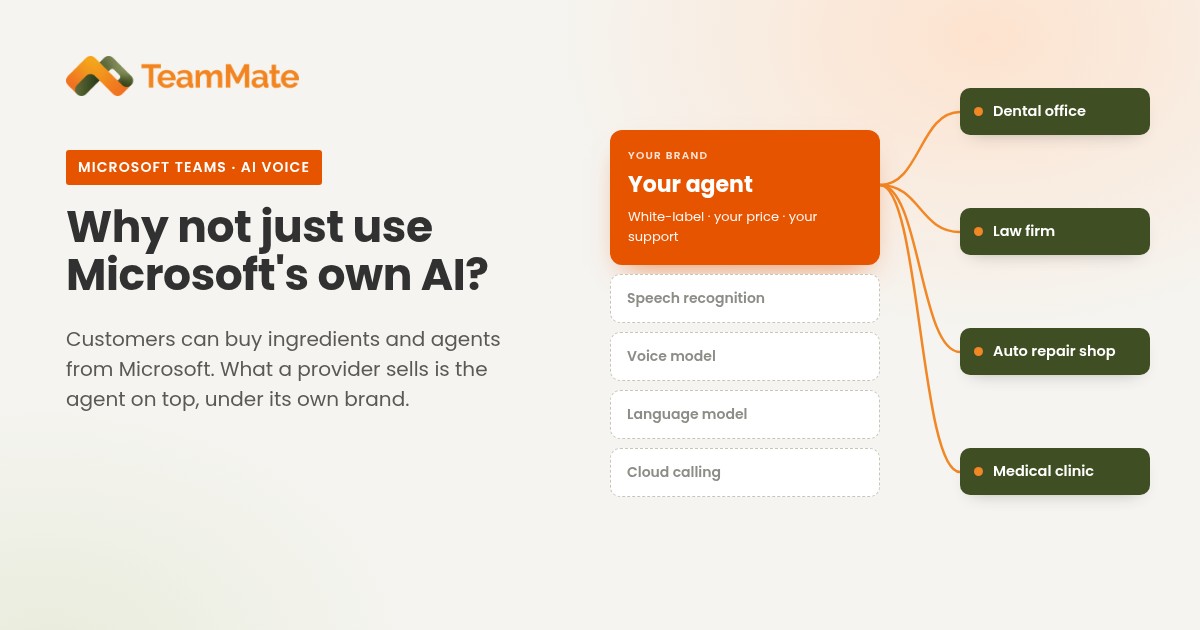
Should service providers just use Microsoft's own AI for Teams voice agents? Microsoft now has two kinds: a finished agent your customer buys directly, and developer building blocks. Neither is something you can resell under your brand. Microsoft Teams Phone Agent became generally available on September 30, 2026, and it's a real option for customers who want a smarter auto attendant. But it's bought and run by the customer in its own Teams tenant, with no white-label or resale version. Microsoft's newest MAI speech models are strong ingredients, but they're in public preview with no service-level agreement. What a UCaaS service provider can sell is the layer on top: a white-label agent with orchestration, provisioning, billing and support.
I get some version of this question from partners almost every week. Their customers are moving to Microsoft Teams, the Teams Phone bundle is squeezing their calling margins, and Microsoft keeps shipping impressive AI. So why not point customers at Microsoft, or build straight on it? It's a fair question, and it deserves a straight answer.
What is Microsoft Teams Phone Agent?
It's Microsoft's own AI voice agent for Teams, and it's generally available. Microsoft's planning overview says Teams Phone Agents "extend auto attendants with AI-driven, human-like conversations that screen calls, answer questions, manage appointments, and route callers without fixed menus." It reached general availability on September 30, 2026.
According to Microsoft's licensing prerequisites, it needs Teams Phone, a resource account (with a free Teams Phone Resource Account license) and Copilot credits. The customer's Teams administrator sets it up in its own tenant.
For an enterprise already deep in Microsoft 365, that's simple to buy. For a service provider, the important part is what's missing: nothing in Microsoft's documentation describes a white-label, provider-branded or resale version. Teams Phone Agent is something your customer buys from Microsoft without you, so it competes with you for the customer relationship. If your customer picks it, you supply at most the phone numbers or the Teams Phone licenses.
What has Microsoft built for developers?
A lot, and it's good. On October 1, Microsoft AI launched MAI-Transcribe-2-Streaming, its first streaming transcription model. Microsoft says it produces first partial transcripts "in just over 100ms of receiving audio" across 60 languages. In the same announcement it introduced two new voice models, MAI-Voice-2.1 and MAI-Voice-2.1-Flash. Microsoft positions Flash for "real-time voice agents and assistants, low-latency call center/IVR flows."
These models plug into the rest of Azure. The Voice Live API combines speech recognition, a generative model and text-to-speech behind a single real-time interface. On the Teams side, Teams Phone extensibility lets an agent built on Azure Communication Services Call Automation answer calls that come through a Teams Auto Attendant or Call Queue, then hand them to a person with context attached.
Put together, the ingredients for a Teams-connected voice agent now live on one cloud. That's good news for everyone who builds on Azure, us included.
Are Microsoft's MAI speech models ready for production calls?
Not on contract terms yet. The documentation for both MAI-Transcribe-2-Streaming and MAI-Voice-2.1 carries the same notice: "This feature is currently in public preview. This preview is provided without a service-level agreement, and is not recommended for production workloads." The Supplemental Terms of Use for Microsoft Azure Previews say previews of generative AI features "are not intended to be used in production or in a live operating environment."
That's how a responsible platform company ships early technology. But your customer's main line is a production workload. If you sell an AI receptionist built on an ingredient with no SLA, you're the one making the commitment to your customer, and nobody is making it to you.
On accuracy, Microsoft says MAI-Transcribe-2-Streaming "ranks no. 1 for accuracy for both final and partial transcripts on Artificial Analysis," citing a third-party streaming speech-to-text benchmark. That's a credible signal. But a leaderboard rank isn't an SLA, and benchmark audio isn't your customer's phone lines, accents and background noise.
Why can't a service provider just resell Microsoft's AI?
Because neither form is built for resale. Teams Phone Agent is licensed to the customer and configured in the customer's tenant. The MAI models and Voice Live are developer services; Microsoft's preview terms describe Azure Communication Services as "a developer product and an input to customers' applications."
What a small business actually buys when it buys "an AI voice agent" is a receptionist that answers in its name, knows its hours, books appointments, transfers to the right person in Teams, and shows up on an invoice it already pays. Someone has to:
- Orchestrate the conversation: turn-taking, interruptions, tool calls, transfers into Teams, and fallbacks when a component misbehaves.
- Provision it across hundreds of customer tenants without a developer on every deployment.
- White-label it so the service provider's brand is what the customer sees and hears.
- Bill for it in a way that fits the provider's catalog and margins.
- Support it, because when the AI receptionist mishears a caller, the customer calls the provider.
Where does differentiation go when the platform owner commoditizes the ingredients?
Up the stack. As Microsoft drives down the price of transcription and voice and pushes up the quality, the ingredients look more and more alike. And with Teams Phone Agent, Microsoft now also sells a finished agent direct to customers.
What a provider can still own is the relationship: one brand, one bill, one support number, and an agent that works across the provider's whole customer base, on Teams and off it. That's where a provider squeezed by the Teams Phone bundle can win back ground.
How does TeamMate fit alongside Microsoft's AI?
TeamMate builds on Microsoft's platform. It runs 100% on Microsoft Azure in 9 regions, is SOC 2 Type 2, and offers 9 products used by more than 30 partners and 500+ service providers in 18 countries.
TeamMate AI Voice Agents is generally available and is built for providers to resell:
- White-label resale: sold under your brand, domain and pricing.
- Path to Teams: connects through Teams Direct Routing using Microsoft-certified session border controllers (SBCs). The AI agent and the Teams users it works with each need a Teams Phone (Microsoft Phone System) license.
- Beyond Teams: the same agents run on your own phone system, such as NetSapiens and other platforms, so you can sell to customers who aren't on Teams.
- Support model: you give first-line support and escalate to TeamMate.
- Proven at scale: 1,000+ agents running, 40+ languages and sub-100ms response time.
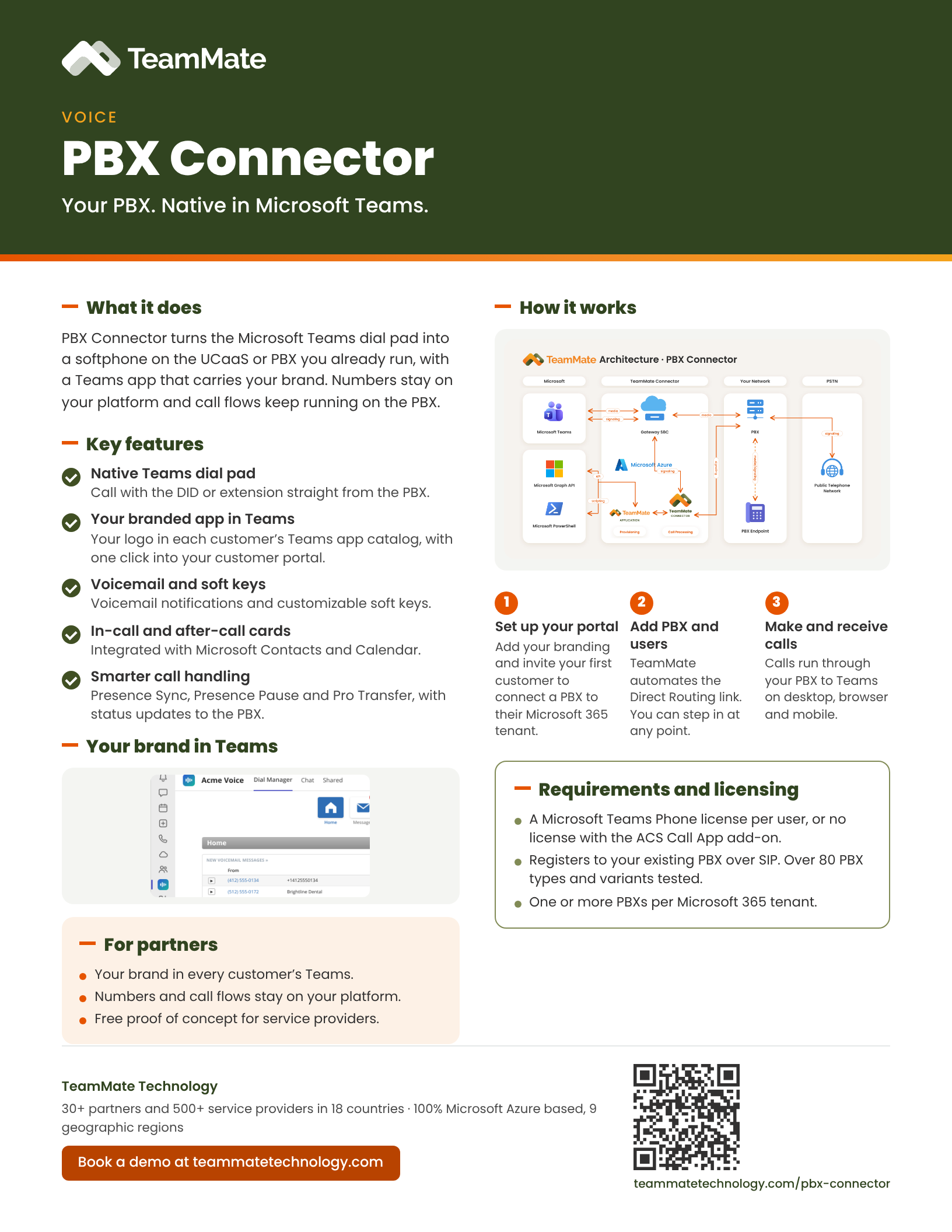
For customers not ready to move their phone system, our PBX Connector connects 80+ PBX types to Teams. And if you're comparing vendors, our buyer's guide to selling AI voice agents for Microsoft Teams gives you a six-point checklist and shows how TeamMate stacks up against the options Microsoft makes visible.
Frequently asked questions
Does Microsoft have its own AI voice agent for Teams?
Yes. Microsoft Teams Phone Agent became generally available on September 30, 2026. It extends Teams auto attendants with AI conversations, and it needs Teams Phone, a resource account and Copilot credits. The customer sets it up in its own Teams admin center.
Can a service provider white-label or resell Microsoft's Teams Phone Agent?
No resale version is described in Microsoft's documentation. Customers buy and run Teams Phone Agent themselves, so it competes with the provider for the customer relationship. TeamMate AI Voice Agents is built for white-label resale.
Are Microsoft's MAI voice models generally available?
Not yet. MAI-Transcribe-2-Streaming and MAI-Voice-2.1 / MAI-Voice-2.1-Flash are in public preview. Microsoft's documentation says the preview "is provided without a service-level agreement, and is not recommended for production workloads."
How does TeamMate AI Voice Agents connect to Microsoft Teams?
Through Teams Direct Routing, using Microsoft-certified session border controllers (SBCs). The AI agent and the Teams users it works with each need a Teams Phone (Microsoft Phone System) license. The same agents also run on the provider's own phone system.
Does TeamMate compete with Microsoft?
TeamMate builds on Microsoft's platform and runs 100% on Azure. Teams Phone Agent is an option a customer can buy directly from Microsoft; TeamMate gives service providers an agent they can sell under their own brand, on Teams and beyond it.
Sell AI voice agents under your own brand
Your customers are moving to Teams either way. The question is whether you sell them the AI layer or someone else does. See how TeamMate AI Voice Agents works: generally available, white-label under your brand, in 40+ languages with sub-100ms response.