“ChatBridge vs Mio: Comparing Cross-Platform Chat Federation Solutions (2026)”
Introduction
As enterprise organizations adopt multiple communication platforms, the need for seamless chat federation has become critical. Two leading solutions—ChatBridge and Mio—offer different approaches to connecting Microsoft Teams, Slack, and other collaboration platforms.
This comprehensive comparison examines the key differences, capabilities, and enterprise suitability of ChatBridge versus Mio for cross-platform communication integration.
Platform Support Comparison
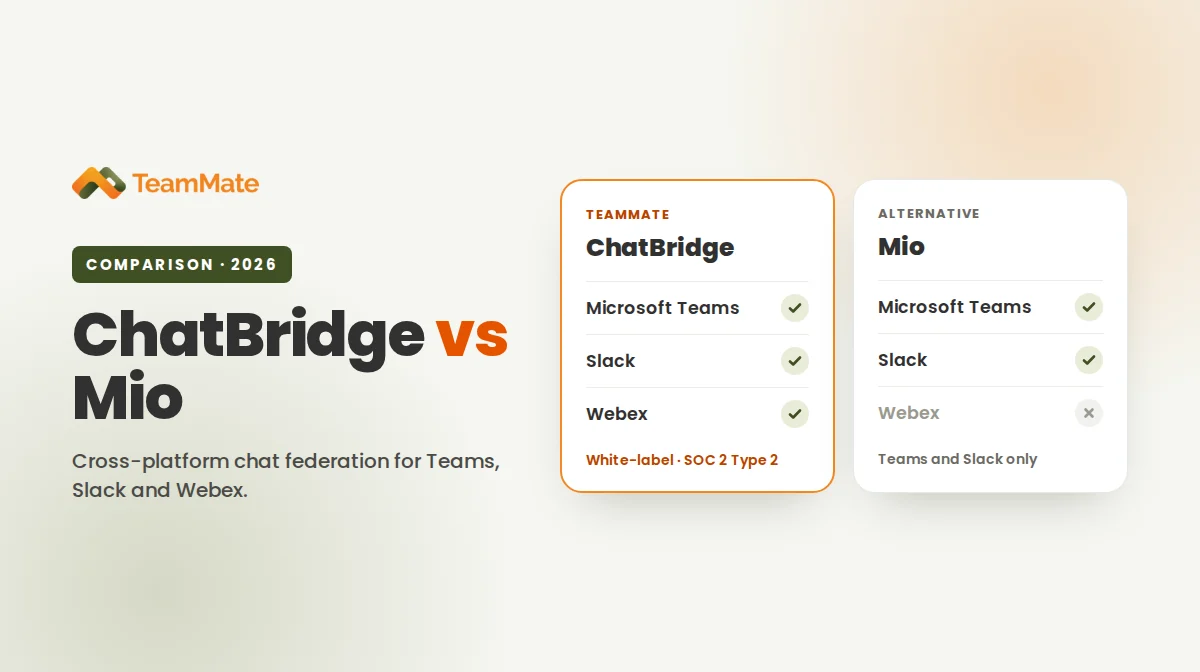
ChatBridge: Three-Platform Federation
Supported Platforms:
- ✅ Microsoft Teams (full integration)
- ✅ Slack (complete feature support)
- ✅ Cisco Webex (comprehensive connectivity)
ChatBridge provides comprehensive federation across all three major enterprise communication platforms, ensuring no platform is left isolated.
Mio: Two-Platform Focus
Supported Platforms:
- ✅ Microsoft Teams
- ✅ Slack
- ❌ Cisco Webex (not supported)
Key Limitation: Mio does not support Webex integration, which can be a significant constraint for organizations using all three platforms.
Feature Comparison
Core Communication Features
Both Solutions Support:
- Bidirectional messaging
- Real-time synchronization
- User identity preservation
- File sharing capabilities
- Emoji and reaction support
ChatBridge Advanced Features
- Three-way federation: Teams ↔ Slack ↔ Webex
- White-label branding: Custom appearance for MSPs
- Multi-layer resale: Support for partner channels
- Advanced API management: Comprehensive automation
- SOC 2 Type 2 certified: Enterprise compliance
Mio Strengths
- Simplified setup: Streamlined two-platform focus
- Established market presence: Longer track record in Teams-Slack integration
- User-friendly interface: Intuitive administration
Enterprise Suitability
Security and Compliance
ChatBridge:
- SOC 2 Type 2 certification
- Comprehensive audit logging
- Enterprise-grade data encryption
- Multi-tenant security architecture
Mio:
- Standard encryption protocols
- Basic audit capabilities
- GDPR compliance features
Scalability and Management
ChatBridge advantages:
- Designed for MSP deployment
- Multi-customer management
- Automated provisioning APIs
- White-label customization
Use Case Scenarios
Choose ChatBridge When:
- Your organization uses Teams, Slack, AND Webex
- You need SOC 2 compliance
- You’re an MSP or service provider requiring white-label solutions
- You need comprehensive API management
- You require multi-customer deployment capabilities
Choose Mio When:
- You only need Teams and Slack integration
- You prefer a simpler, established solution
- Webex integration is not required
- You need quick deployment with minimal configuration
Pricing Considerations
ChatBridge: Pricing structured for enterprise deployment with volume discounts and MSP partnership options. Contact for custom enterprise pricing.
Mio: Per-user monthly pricing model. Standard enterprise licensing available.
Note: Both solutions offer trial periods and custom enterprise pricing. Contact providers directly for detailed quotes.
Decision Matrix
| Feature | ChatBridge | Mio |
|---|---|---|
| Platform Support | Teams + Slack + Webex | Teams + Slack only |
| Enterprise Security | SOC 2 Type 2 | Standard |
| White-Label | ✅ Full branding | ❌ Limited |
| MSP Features | ✅ Multi-tenant | ❌ Single tenant |
| Setup Complexity | Moderate | Simple |
| Market Maturity | Growing | Established |
Conclusion
The choice between ChatBridge and Mio depends on your organization’s specific platform requirements and enterprise needs.
ChatBridge is the clear choice for organizations requiring comprehensive three-platform integration (Teams, Slack, Webex), SOC 2 compliance, and MSP-grade features. Its broader platform support and enterprise capabilities make it ideal for complex deployment scenarios.
Mio remains a solid option for organizations focused solely on Teams-Slack integration who prioritize simplicity and proven market presence.
Ready to explore ChatBridge? Contact TeamMate Technology to learn how comprehensive chat federation can unify your organization’s communication platforms across Teams, Slack, and Webex.