CallTower Bought Momentum's Voice Business. What Should Independent UCaaS Providers Do Now?
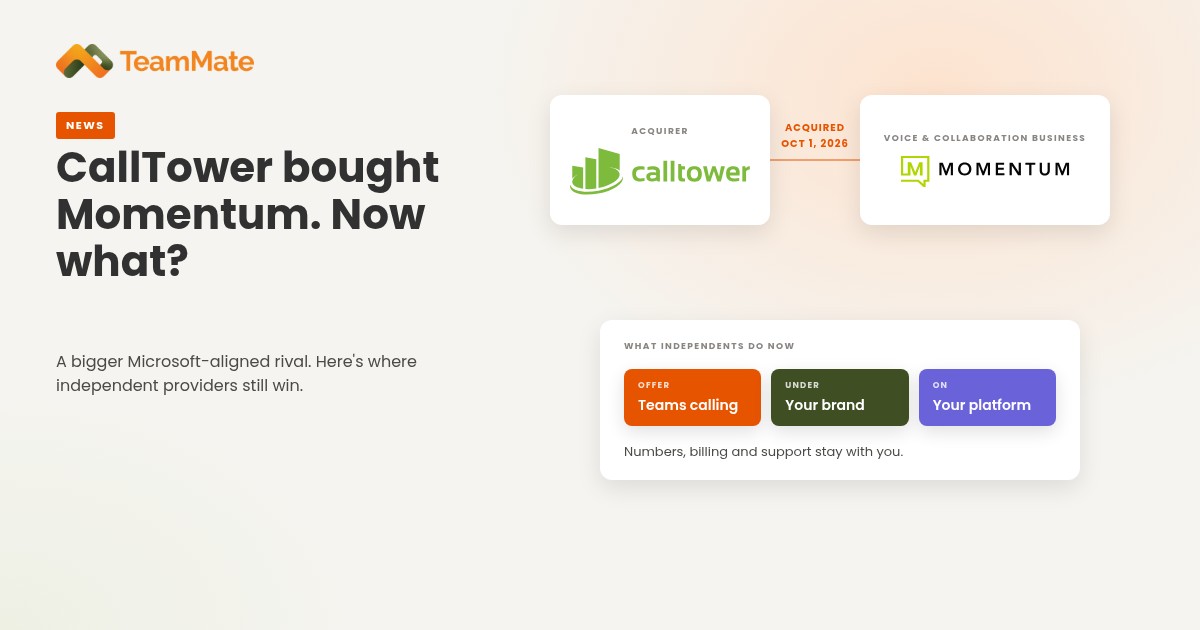
What does the CallTower–Momentum deal mean for independent UCaaS providers? It means a larger, Microsoft-aligned competitor is now selling managed Teams voice to more accounts, and the best response is to offer Teams calling under your own brand before that competitor offers it to your customers. On October 1, 2026, CallTower completed its acquisition of Momentum Telecom's cloud voice and collaboration business. You don't answer that by abandoning your platform. You answer it by bringing Teams to the customers who already trust you.
I have a lot of respect for both companies. CallTower and Momentum have each spent years helping businesses put voice into Microsoft Teams, and the combination makes sense on paper. That's exactly why independent UCaaS and hosted PBX providers should take it seriously.
What happened in the CallTower–Momentum deal?
CallTower acquired Momentum's cloud voice and collaboration business, and the deal closed on October 1, 2026. According to CallTower's October 1, 2026 announcement, CallTower "completed the acquisition of assets associated with Momentum Telecom's ('Momentum') cloud voice and collaboration business, including its customer relationships."
The published facts:
- Size. The transaction "brings more than 3,500 Momentum customers and over 250 employees to CallTower, expanding its customer base to more than 8,500 organizations." No price, revenue or seat count was disclosed.
- Name. The combined voice business operates as CallTower. Momentum "will continue operating independently," keeping its network connectivity and managed services businesses under the Momentum name.
- Leadership. Four Momentum leaders join CallTower's executive team: Mark Marquez as Chief Technology Officer, Jennifer Jacobs as Chief Operating Officer, Heather Levenberg as Senior Vice President of Human Resources and Joe Coomes as Senior Vice President and General Counsel.
- Ownership. Court Square Capital Partners acquired a majority stake in CallTower in April 2026. Dechert, which advised Momentum and Court Square, describes the deal as one that "brings together parts of two Court Square portfolio companies."
CallTower President and CEO Bret England said: "This acquisition marks a defining moment in CallTower's growth. With expanded voice expertise, a broader portfolio of communications products, and greater technical and operational capacity, CallTower is better positioned to help enterprises modernize legacy communications, navigate complex UC, CX, and AI technology environments, and deliver connected experiences for employees and customers worldwide."
How did CallTower and Momentum position themselves on Microsoft Teams?
Both put Teams front and center. CallTower's Microsoft Teams page says "CallTower is a Microsoft Solutions Partner, specializing in Modern Work – Calling for Microsoft Teams," and its Operator Connect page states, "We were among the initial group of Operators selected by Microsoft to launch Operator Connect."
Momentum sold Teams voice too. Its transition page lists "Microsoft Teams Phone, Operator Connect and Direct Routing" among the services that moved to CallTower, along with Teams contact center, call recording and AI-powered business messaging.
To be precise, CallTower doesn't describe itself as Teams-only. It supports Microsoft Teams, Webex by Cisco, Zoom, Five9 and Genesys, and Court Square called it "a solution-agnostic provider." But on Microsoft voice, the combined business now has two established Teams practices under one roof.
Why is a larger, Microsoft-aligned competitor a real threat?
Because it shows up with the answer your customer's IT team is already looking for. Four things stand out.
Scale. More than 8,500 organizations, by CallTower's count, plus the people and technology that came with Momentum's voice business. Scale funds sales coverage, partner programs and product investment.
A Microsoft-aligned pitch. When a customer standardizes on Microsoft 365, "we're a Microsoft Solutions Partner and an Operator Connect launch operator" is an easy story to buy. It matches the direction IT has already chosen.
Enterprise accounts. CallTower targets mid-market and enterprise organizations across many countries. Those accounts set the expectations that trickle down to the SMB and mid-market customers most independent providers serve.
Managed Teams voice. The pitch isn't just dial tone. It's Operator Connect or Direct Routing plus implementation, support and add-ons, delivered as a managed service. That's a complete answer to "how do we get calling into Teams?"
If you run a hosted PBX or UCaaS platform, here's what to plan for: a customer rolls out Teams, someone asks why calls live in a separate app, and a Teams specialist offers to make the problem go away.
Where do independent UCaaS providers still have the advantage?
In more places than the headline suggests.
- Your own platform and features. You built the call flows, IVRs, queues, integrations and reporting your customers depend on. They aren't something a customer gives up lightly.
- Customer intimacy. You know the office manager by name and you know why the night-service schedule is set the way it is. That relationship is hard to replicate from the outside.
- Multi-platform customers. Plenty of businesses use Teams for some people, desk phones for others, and analog devices or contact center seats somewhere else. Your platform already serves all of them.
- Speed. A smaller, focused provider can say yes, configure and ship faster for its own customers.
- No migration disruption. If you bring Teams calling to the customer, their numbers and call flows don't have to move anywhere. The change happens in the app their users click, not in the phone system.
None of these advantages counts for much if a competitor is the first to talk to your customer about Teams. That's what has to change.
What should independent UCaaS providers do now?
Offer Teams calling under your own brand, without abandoning your platform
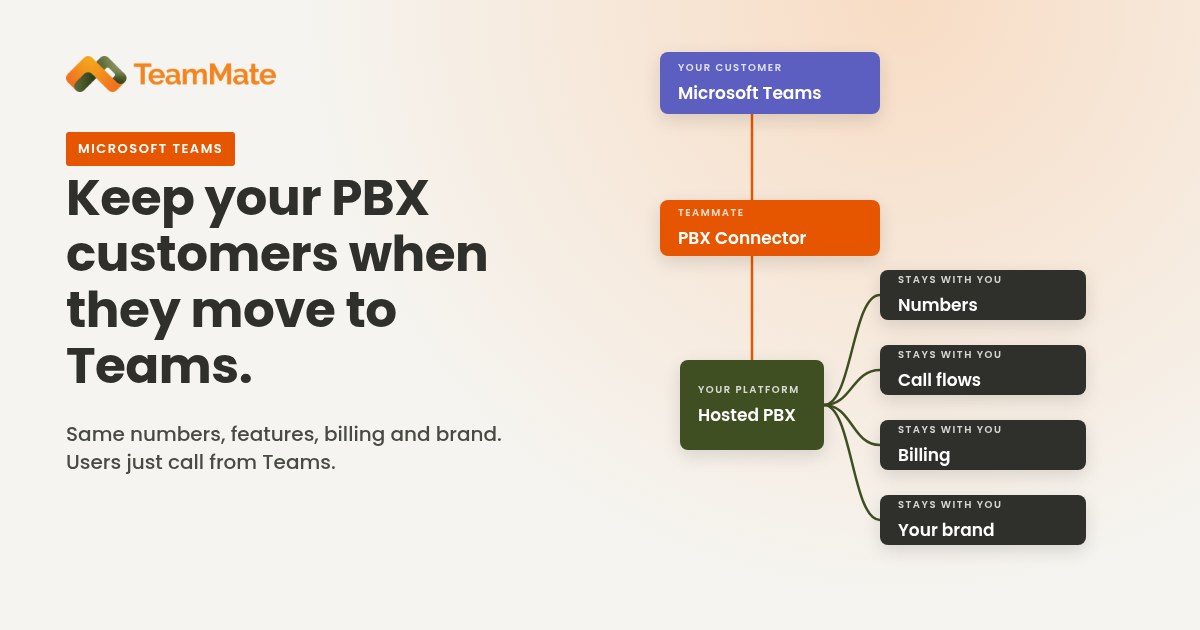
You don't have to choose between your platform and Teams. TeamMate PBX Connector connects 80+ PBX types to Teams. In every deployment, numbers stay on your platform with no port-out, and call flows keep running on your PBX. Users call from Teams, and you stay on the invoice.
Licensing matters to the customer, so be clear about it. PBX Connector on its own requires a Teams Phone license per user. With the ACS Call App add-on, no Teams Phone license is needed. The ACS Call App's mobile companion app runs on iOS and Android only; there's no desktop app.
If some customers want a Microsoft-native Operator Connect option, you can offer that too. Operator Connect Express lets providers become Operator Connect carriers quickly and deploys in days. That puts you in the same Teams admin center conversation as the larger operators, under your name.
Lead the Teams conversation with your existing base
Don't wait for the renewal call. Go through your customer list and flag accounts that are rolling out Microsoft 365, moving to E5, or asking help-desk questions about calling from Teams. Bring them a plan: what stays the same (numbers, call flows, support, invoice), what changes (users call from Teams), and how long it takes. I covered the account-by-account playbook in How to Keep Your PBX Customers When They Move to Teams Phone.
The provider who frames the Teams decision first usually wins it. Right now, you can be that provider for the customers who already know you.
Add value-added services inside Teams
A consolidator's pitch is strongest when it's broader than dial tone, so make yours broader too. Teams Call Recording and AI Voice Agents are white-label, so they carry your brand. AI Voice Agents supports 40+ languages with sub-100ms response. SMS Connector adds business texting, and ChatBridge adds chat. Each one gives a Teams user a reason to stay with you, and adds revenue to an account you already serve.
All of it runs 100% on Microsoft Azure in 9 regions, and TeamMate is SOC 2 Type 2. More than 30 partners and 500+ service providers in 18 countries use the platform.
Frequently asked questions
What did CallTower acquire from Momentum?
On October 1, 2026, CallTower completed the acquisition of assets associated with Momentum Telecom's cloud voice and collaboration business, including its customer relationships. Momentum continues operating independently with its network connectivity and managed services businesses.
How big is CallTower after the Momentum acquisition?
CallTower says the transaction brings more than 3,500 Momentum customers and over 250 employees to CallTower, expanding its customer base to more than 8,500 organizations. No purchase price or revenue figures were disclosed.
Can a UCaaS provider offer Microsoft Teams calling without leaving its own platform?
Yes. TeamMate PBX Connector connects 80+ PBX types to Teams, and in every deployment numbers stay on the provider's platform and call flows keep running on the PBX. PBX Connector on its own requires a Teams Phone license per user; with the ACS Call App add-on, no Teams Phone license is needed.
Can a smaller provider become an Operator Connect carrier?
Yes. TeamMate Operator Connect Express lets providers become Operator Connect carriers quickly and deploys in days.
Bring Teams to your customers before someone else does
A bigger Teams competitor doesn't make your platform less valuable. It makes the Teams conversation more urgent. See how TeamMate PBX Connector works and offer Teams calling under your own brand, on your own platform, to the customers who already trust you.