Why are AI voice agents a big opportunity for UCaaS providers? The phone seat has turned into a commodity, but the work of answering the phone hasn't. AI voice agents let a provider bill for that work, which comes out of a different budget, earns a better margin and ties the provider into how the customer's business runs. Providers that sell agents through partners who know their customers, and charge for them, get new revenue and lower churn from the same product.
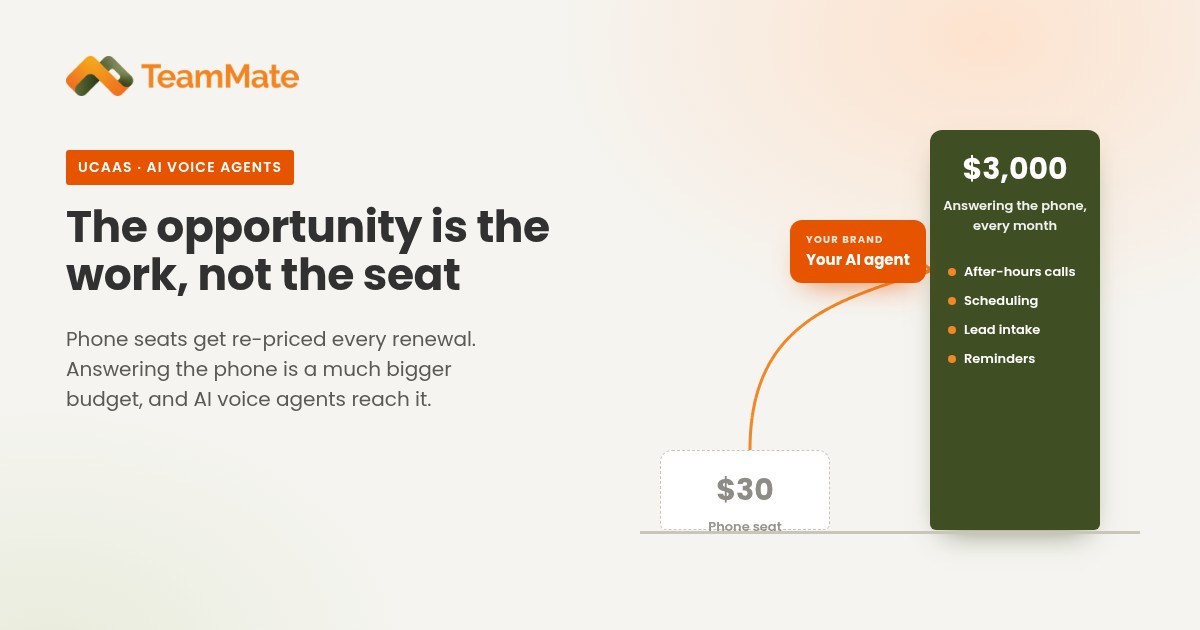
The UCaaS industry has spent fifteen years competing over a phone seat of about $30 a month. Meanwhile the customer has been paying around $3,000 a month for the person who answers that phone. AI voice agents are the first product in this category that can reach the second budget.
Why is the UCaaS seat under pressure?
The economics of the seat have changed. Cavell reports that more than 40% of UCaaS providers saw revenue fall over the past three years. Cavell also finds that nearly half of new UCaaS customers are now won from a competitor rather than converted from an on-premises PBX. In that kind of takeover deal you compete on price, against a service that's largely the same as yours.
The seat count is shrinking too. Gartner projects traditional telephony spend will fall roughly 40% by 2029 compared with 2026. Internal calls are moving into collaboration tools.
The seats that survive are customer-facing ones: the front desk, the published number, the inbound line where the caller is outside the company. That's exactly where a voice agent works.
Why can't you win by adding more self-service features?
Anything a customer can switch on themselves, which works the same way for every business, is a fight on price against much bigger competitors. The rule of thumb is simple: if a customer can switch it on without you, there's a good chance you'll lose it eventually. If it took you understanding how their business runs, you can keep it.
AI voice agents are that second kind of product. Writing a lead into a CRM, booking into a practice management system, or catching the after-hours calls one clinic's revenue depends on all take knowing the business. A workflow that matters enormously to a few thousand dental clinics is too small for a mass-market roadmap. That's the opening.
Why is your channel the real advantage?
The knowledge this work needs isn't held by the platform. It's held in the channel. Your resellers, agents and MSPs ran the discovery, know the market, and often serve twenty other businesses that look almost the same. That knowledge is already spread across your partner base.
For years, bundled and self-service products shrank the partner's job to provisioning. Voice agents hand back a consultative role: work out which workflow to automate for which business, then build it. Every quarter a partner spends learning a vertical is knowledge that compounds, so starting early matters.
How do AI voice agents reduce churn?
They give the customer something they'd have to give up to leave, in three ways:
- Entanglement. A seat is portable by design. An agent that answers the published number, writes into the CRM or practice management system and handles after-hours bookings isn't. Moving it is an operational project with real risk.
- Value re-anchoring. A seat gets re-priced against a competitor's quote at every renewal. A line item that captured 40 after-hours leads last month gets measured against what those leads were worth.
- A reason to be in the room. The agent produces a monthly record of calls handled, leads captured and appointments booked. It's a business review that writes itself, for accounts that were never big enough to justify one, and the partner brings it.
Should you give AI voice agents away to protect the base?
No. It's tempting to bundle AI for free to drive adoption, but the evidence points the other way. Zoom gave its AI away for eleven quarters and expansion drifted down. When it started charging $10 to $20 for it, enterprise growth hit 7.8%, its fastest in three years, and paid AI showed up in nine of its ten largest customer-experience deals.
The reason is simple: nobody deploys what nobody paid for. Free AI gets switched on, never configured, and never produces a number anyone sees. A paid line item gets a deployment conversation, an owner at the customer, and a review at 90 days. And a partner can't build a practice on something you give away. Charging for the agent is what makes the retention work.
How much new revenue can voice AI add?
Providers already selling voice AI are reporting it in their results:
- RingCentral: its AI Receptionist went from roughly 3,100 paying customers to more than 16,000 in a year. Customers using at least one paid AI product now represent about 13% of annual recurring revenue, double a year earlier.
- 8x8: usage-based revenue grew more than 70% year over year in Q4 of fiscal 2026 and reached 23% of service revenue, and voice AI usage grew more than 3.3x across the year.
It also grows within each account. After-hours answering is one workflow. Scheduling, intake and qualification, deposit collection, reminders and follow-up are others, and each is a separate deployment and line item. That's an expansion motion your channel already knows how to run.
With TeamMate, partners typically add $50 to $250 per account each month.
Why are UCaaS providers better placed than CRM vendors or integrators?
Others want this market too. Software vendors can build agents that write to their own database, and integrators can build agents as projects. But UCaaS providers have advantages neither can easily copy:
- You hold the number. The published number is the front door of the business, and it's on your platform. Anyone else has to port it away or forward it.
- You already handle telecom. E911, STIR/SHAKEN, CNAM, number porting, 10DLC, TCPA, carrier interconnects and communications taxes. A software company adding voice has to learn all of it.
- You handle every call, not just one use case. Vendors calling about invoices, wrong numbers, emergencies, and callers who need a person right now. Queues, transfers, voicemail and handing off to a person are already yours.
- The agent can be an extension, not a trunk. On your platform the agent sits in the ring group, takes overflow, covers after hours and transfers like a person would, with caller ID and context intact. Recording and reporting pick it up automatically.
- You're neutral across systems. The phone touches the CRM, the scheduler and the payment processor, so your agent can write to whichever one the workflow needs.
- You run it every day. A voice agent isn't a one-off project. It needs monitoring, prompt updates and support, and you already run a network operations center and a support desk.
- You already serve the right customers. Clinics, dealers and agencies where the phone is the business, at a price point you already bill, support and keep.
The CRM vendor has to become a telco. The integrator has to become an operator. You just have to add a product.
How can a UCaaS provider start selling AI voice agents?
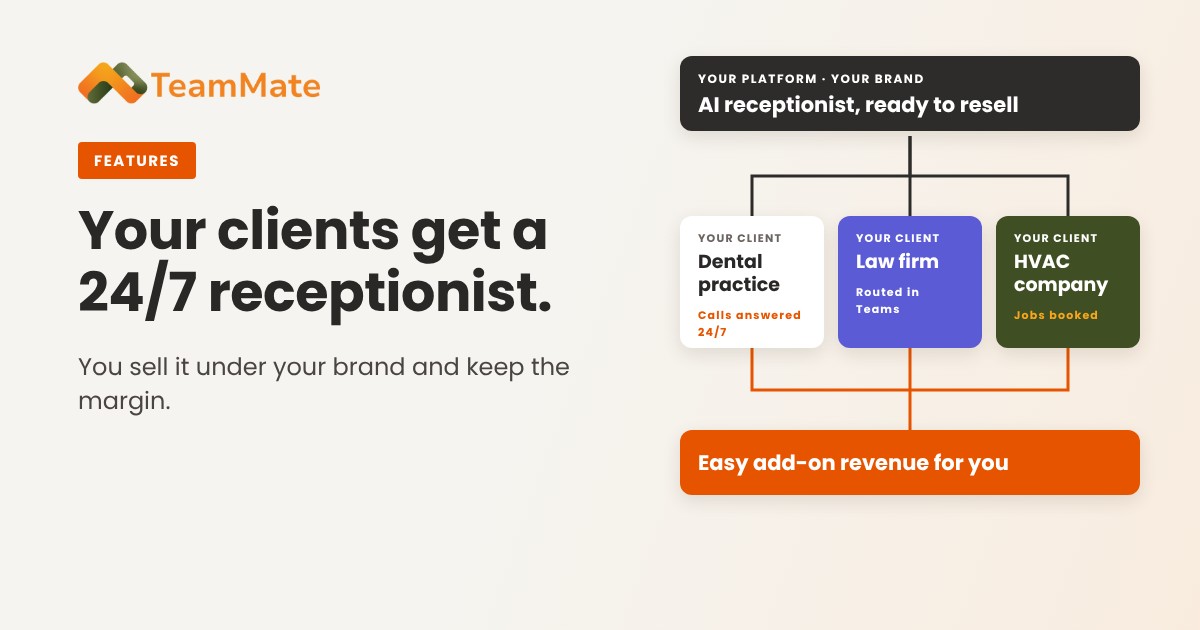
TeamMate AI Voice Agents is built for providers to resell:
- White-label: sold under your brand, with your pricing.
- On your own phone system: works on platforms such as NetSapiens and others. See AI Voice Agents for NetSapiens.
- Proven: 1,000+ agents running, in 40+ languages, with sub-100ms response time.
- Templates to start from, so a partner isn't building from scratch. See 7 AI voice agent templates and where each one wins.
- A support model built for the channel: you give first-line support and escalate to TeamMate.
- Revenue: partners typically add $50 to $250 per account each month.
Point your channel at workflows instead of seats, charge for the agent, and start now. Service providers can start with a free 30-day proof of concept.
Frequently asked questions
Why are AI voice agents an opportunity for UCaaS providers?
They let providers bill for answering calls, which comes from a bigger budget than the phone seat and isn't priced against a commodity. They also make accounts harder to leave, because the agent is tied into how the customer's business runs.
Should UCaaS providers include AI voice agents for free?
No. Free AI tends to go unused. A paid agent gets a proper deployment, an owner at the customer and a review, which is what creates the stickiness. It also gives partners a margin to do the work.
How do AI voice agents reduce churn?
Through entanglement with the customer's systems and workflows, value measured in leads and bookings rather than seat price, and a monthly report that gives the partner a reason to meet the customer.
Why are UCaaS providers better placed than CRM vendors to sell voice agents?
The provider already holds the customer's phone number, handles telecom compliance, owns every call path including handoff to a person, and runs support every day. The agent can sit on the platform as an extension rather than a bolt-on.
How much can a provider charge for an AI voice agent?
With TeamMate AI Voice Agents, partners typically add $50 to $250 per account each month, under their own brand.