Every business has a version of the same person. The receptionist, office manager or service coordinator who answers the same ten questions all day. What are your hours? Can I reschedule? Who handles billing? They are good at it, and that is the problem. Their talent is spent on calls that never needed a human.
AI is already giving workers time back. In the U.S. Census Bureau's March 2026 survey, about 55% of workers said they have used AI on the job, and roughly a third of recent users said it saved them one to two hours (U.S. Census Bureau).
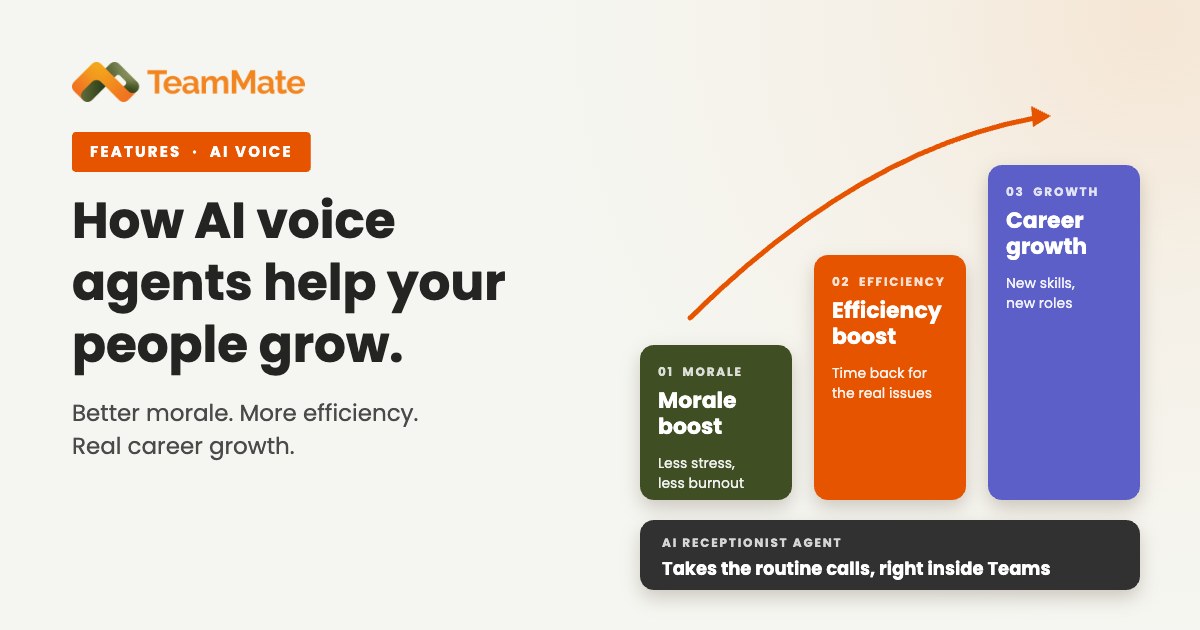
The question for your customers is not whether an AI voice agent can answer the phone. It is what their people will do with the time it gives back. Get that right and you get two wins at once: a morale boost for staff and an efficiency boost for the business. That is where career growth starts.
The hidden cost of routine calls
Routine calls cost more than wages. They wear people down.
- Engagement is falling. Gallup reports global employee engagement dropped to 20% in 2025, the lowest since 2020, with an estimated $10 trillion in lost productivity (Gallup).
- The front desk churns first. MGMA found front-office turnover in medical practices hit 40% in 2022 (MGMA), and its May 2026 poll still names front-desk and administrative staff among the hardest roles to keep (MGMA).
- Every exit is expensive. Gallup estimates replacing a frontline employee costs about 40% of their salary, and up to 200% for managers (WJLA).
When good people spend their day on repetitive calls, they stop growing. Then they leave, and the business pays to train someone new for the same treadmill.
What happens when the routine is handled
An AI voice agent takes the predictable calls: hours, directions, scheduling, message taking and after-hours triage. That shift delivers two different kinds of value.
A morale boost. Fewer interruptions mean more focus and less stress. Staff stop being the human switchboard and start handling the calls that need judgment, empathy and a real decision. The difficult conversations still happen, but now people have the energy for them.
An efficiency boost. The time adds up. BCG's 2026 AI at Work research found 42% of regular AI users save eight hours a week. It also found 66% of employees get little or no guidance on how to use that time (BCG AI at Work 2026 summary).
That second number is the real opportunity. Saved time only becomes growth when leaders redirect it on purpose.
From freed-up time to career growth
Microsoft's 2026 Work Trend Index describes the shift: as AI agents take on execution, employees move toward designing workflows, delegating to agents and focusing on judgment and decisions (Pulse 2.0).
The research backs it up:
- Newer staff improve fastest. A Stanford and MIT study of more than 5,000 support agents found AI assistance lifted productivity 14% on average and 34% for novice workers, while improving customer sentiment and employee retention (NBER).
- New responsibilities appear. Forrester expects frontline reps to supervise AI agents, handle exceptions and feed back improvements (destinationCRM).
In a small or mid-sized business, that becomes real career paths:
- Receptionist to AI agent owner. Tunes the prompts, updates the knowledge base and reviews call summaries.
- Front desk to customer success. Uses freed-up hours to follow up on leads, win back lapsed customers and handle complex accounts.
- Office manager to operations lead. Uses call data to spot bottlenecks and improve processes.
These are skills people can put on a resume. That makes the agent a retention tool, not a threat.
Answering "will AI replace my team?"
This is the first question many customers ask. The data gives partners a confident answer.
- Gartner found only 20% of customer service leaders have reduced staffing because of AI, while most kept headcount steady and supported more customers (Gartner).
- Nearly 80% of organizations plan to move some agents into new roles, and 84% plan to add new frontline skills (Gartner).
Talking points that land:
- "The agent takes the tasks, not the jobs."
- "Turn your receptionist into your best follow-up person."
- "Keep the people you already trained, and give them a reason to stay."
Why it works inside Microsoft Teams
For businesses that run on Teams, the TeamMate AI Receptionist Agent works where staff already spend their day. No new app, no new screen.
- Native connection. Connects through Teams Direct Routing using Microsoft-certified SBCs.
- Smart routing. Looks up people in the Teams directory and sends callers to the right person, replacing multi-level auto-attendants.
- Context before pickup. Adaptive Call Cards show what the caller wants while the phone rings, so nobody answers blind.
- Follow-up built in. Every call is transcribed and summarized. The summary posts in Teams with the caller, reason, outcome and action items, plus Call back, View transcript and Assign buttons. Sensitive details are redacted.
- Templates that free real time. Message Taker, Scheduling, After Hours Helpdesk and Notetaker cover the most common routine calls.
Admins should note that the agent and each Teams user it works with need a Teams Phone license.
Not every customer runs Teams. The same agent also works on other UCaaS platforms, including NetSapiens, so partners can offer it across their whole customer base.
Bring this story to your customers
Most AI voice pitches stop at cost savings. Lead with people instead. Show customers how the TeamMate AI Receptionist Agent gives staff time back, lifts morale and opens real career paths, and the efficiency gains follow.
- Explore AI Voice Agents
- Read the buyer's guide: Selling AI Voice Agents for Microsoft Teams
- Start a free 30-day proof of concept
- Become a TeamMate partner
- Book a demo